Food for Language by MCIS Language Services Collective & Latha Sukumar & Olaguer Chacon
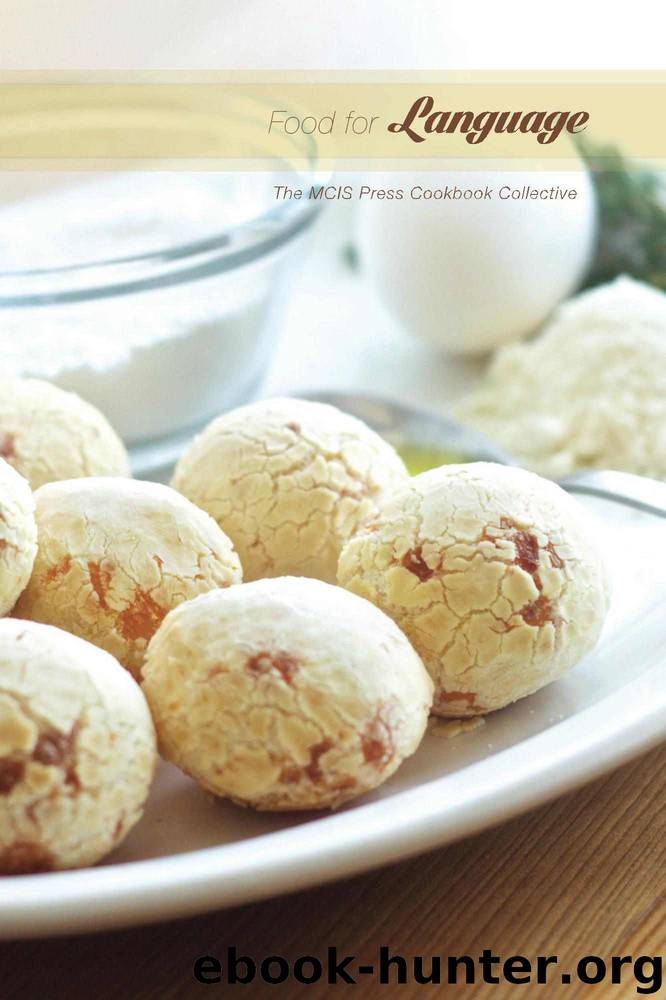
Author:MCIS Language Services Collective & Latha Sukumar & Olaguer Chacon
Language: eng
Format: epub
Publisher: The MCIS Press
Published: 2014-01-08T16:00:00+00:00
the story of idiyappam
________________
Sriranjani Vijenthira Sriranjani Vijenthira is an interpreter, translator, former high school science teacher, and published writer of Tamil inspired short stories. Sriranjani shared with us the recipe for idiyappam, a nurturing dish of Tamil origin.
“Idiyappam is a staple food for Sri Lankan Tamils. It is made of very thin, mostly rice flour, swirled together into a round shape, sort of like funnel cake. Generally it is served as the main course at breakfast or as a side dish at dinner. Idiyappam can be combined with all types of curries, from the humble sambol* and sothi** to omelettes and meats, hot and sweet dishes alike. Idiyappam is simple, healthy, with an excellent taste. The cellulose in rice or wheat is broken apart by exhaustive powdering, roasting, soaking, and steaming so amongst all of our food idiyappam is the easiest one to digest, even with people who are ill and have general troubles with eating. It’s also inexpensive and easy to make as there is no Tamil food stall in Canada that doesn’t sell it. Because of this, Canadian Tamils usually don’t make it at home. Why would you when you can but up to 25 idiyappam with sambol and sothi for only $3.
The recipe has not changed much since my arrival in Canada except sometimes atta flour is used for the diabetic. However, here a brand new “Canadian” form called idiyappa biriyani has evolved that asks for scrambled eggs or vegetables to be added.
Idiyappam is also both my father’s and my husband’s favourite food and over the years I found that the easiest way to make them happy or to cool down their (occasional) hot temper is to serve idiyappam with sothi. The word idiyappam comes from “idi”, Old Tamil/ Dravidian for flour, especially of rice or millet. Appam is anything that is steamed or made into a cake. In old Tamil literature there is a particular reference to the makers of string-like food. The word takes its meaning from Poovarasu maram (portia/umbrella tree)referring to a type of a hard but elastic wood preferred in making Idiyappa Ural, or umbrella strings, because this type of wood can withstand the pressure exerted onto the handles. In the past, people used a certain type of pottery steamer called moodu-paanai and in Jaffna there was a community sustained exclusively by making and selling idiyappam.
You start making idiyappam by mixing rice or wheat flour with hot water and seasoning it with salt, then the dough is kneaded until smooth. The Idiyappa Ural, a special piece of equipment traditionally made out of wood, has two parts, a mould the dough is placed into then pressed, and the upper part which comes down and applies the pressure by using both hands. The pressed dough is placed onto Idiyappa thattu (trays) and the noodles are swirled, and then steamed for 5 to 10 minutes. In Jaffna and other parts of Sri Lanka this traditional kitchen equipment still exists and is used daily.
*Sambol - a traditional
Download
This site does not store any files on its server. We only index and link to content provided by other sites. Please contact the content providers to delete copyright contents if any and email us, we'll remove relevant links or contents immediately.
Whiskies (Collins Gem) by dominic roskrow(45233)
101 Whiskies to Try Before You Die by Ian Buxton(44995)
World's Best Whiskies by Dominic Roskrow(44892)
Whiskies Galore by Ian Buxton(41975)
The Fast Metabolism Diet Cookbook by Haylie Pomroy(21125)
Chic & Unique Celebration Cakes by Zoe Clark(20044)
Craft Beer for the Homebrewer by Michael Agnew(18222)
The Bone Broth Miracle: How an Ancient Remedy Can Improve Health, Fight Aging, and Boost Beauty by Ariane Resnick(16593)
For the Love of Europe by Rick Steves(13837)
Tools of Titans by Timothy Ferriss(8355)
A Court of Wings and Ruin by Sarah J. Maas(7798)
How to Be a Bawse: A Guide to Conquering Life by Lilly Singh(7464)
Chowders and Soups by Liz Feltham(7380)
The Institute by Stephen King(7019)
Cravings: Recipes for All the Food You Want to Eat by Chrissy Teigen & Adeena Sussman(6773)
Wiseguy by Nicholas Pileggi(5757)
The Last Wish (The Witcher Book 1) by Andrzej Sapkowski(5445)
Spare by Prince Harry The Duke of Sussex(5168)
Room 212 by Kate Stewart(5095)
